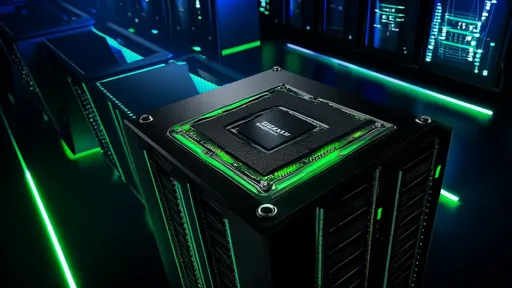
The technology world witnessed a significant milestone as NVIDIA's Blackwell GPU architecture was officially recognized among the Top 10 Global Engineering Achievements of 2025, standing alongside other groundbreaking innovations that are reshaping our technological landscape. This prestigious recognition, announced by an international consortium of engineering academies and technology institutions, highlights the architecture's profound impact on computational capabilities and its potential to drive the next wave of technological advancement across multiple industries.
Named in honor of David Harold Blackwell, the renowned mathematician and statistician who made significant contributions to game theory and probability, the Blackwell architecture represents more than just another iteration in GPU development. It embodies a fundamental rethinking of how computational resources can be organized and deployed to tackle increasingly complex challenges in artificial intelligence, scientific research, and data analysis. The selection committee particularly noted the architecture's innovative approach to scaling computational power while managing energy consumption—a critical consideration in an era of growing environmental awareness.
What sets the Blackwell architecture apart is its revolutionary multi-die design, which represents a departure from traditional monolithic GPU architectures. By implementing a sophisticated chiplet approach, NVIDIA has managed to overcome previous limitations in manufacturing yield and performance scaling. This design philosophy allows for better thermal management and more efficient resource allocation, enabling the architecture to deliver unprecedented computational density. Industry analysts have described this approach as potentially setting a new standard for high-performance computing architectures in the coming decade.
The architecture's significance extends far beyond technical specifications. Blackwell's real impact lies in its ability to accelerate the development and deployment of large-scale AI models that were previously constrained by computational limitations. Research institutions working on climate modeling, pharmaceutical development, and astrophysics simulations have reported order-of-magnitude improvements in their computational workflows. This acceleration capability positions Blackwell as a critical enabler for scientific discoveries that could address some of humanity's most pressing challenges.
In the commercial sector, the adoption of Blackwell-based systems is already transforming business operations. Financial institutions are leveraging the architecture's capabilities for real-time risk analysis and fraud detection at scales previously unimaginable. Manufacturing companies are implementing complex digital twins that simulate entire production processes, optimizing efficiency and reducing waste. The architecture's balanced approach to performance and power efficiency has made it particularly attractive for data center deployments, where operational costs have become increasingly significant.
The recognition of Blackwell comes at a pivotal moment in the evolution of computing technology. As Moore's Law shows signs of slowing, the industry has been searching for alternative paths to continued performance improvements. Blackwell's architecture demonstrates that innovative design and system-level optimization can deliver substantial gains even as traditional semiconductor scaling becomes more challenging. This achievement suggests that the future of computational progress may depend less on transistor density alone and more on architectural creativity and system-level integration.
Environmental considerations played a notable role in the architecture's recognition. The selection committee specifically highlighted Blackwell's energy efficiency advancements, which enable significant computational work while reducing the carbon footprint associated with large-scale computing operations. This aspect has resonated particularly strongly in regions where regulations around data center energy consumption are becoming increasingly stringent. The architecture's power management features represent a meaningful step toward sustainable high-performance computing.
Beyond its immediate technical achievements, the Blackwell architecture is influencing how engineers and researchers think about problem-solving in computational domains. Its success has sparked renewed interest in heterogeneous computing approaches and specialized accelerators for specific workloads. Academic institutions are already incorporating studies of the Blackwell architecture into their computer engineering curricula, recognizing its importance as a case study in modern system design.
The global nature of the recognition underscores how technological innovation has become increasingly collaborative across international boundaries. While NVIDIA led the development, the architecture incorporates advancements from research institutions and manufacturing partners around the world. This collaborative aspect reflects the growing complexity of cutting-edge engineering projects, which often require expertise spanning multiple disciplines and geographies.
Looking forward, the implications of Blackwell's architectural innovations are likely to extend well beyond its immediate applications. The principles demonstrated in its design are already influencing development roadmaps across the semiconductor industry. Competing companies are studying the architecture's approach to memory hierarchy, interconnect technology, and power distribution, seeking to incorporate similar concepts into their own future products. This ripple effect suggests that Blackwell's impact will be felt throughout the computing industry for years to come.
The recognition also highlights the growing importance of GPU technology in the broader technological ecosystem. Once primarily associated with gaming and graphics rendering, GPU architectures have evolved into fundamental building blocks for artificial intelligence, scientific computing, and data analysis. Blackwell's placement among the top engineering achievements of 2025 signals this transition to mainstream recognition of GPUs as general-purpose computational engines rather than specialized graphics processors.
As organizations worldwide continue to deploy Blackwell-based systems, the architecture's full potential is still being discovered. Early adopters report that the system's flexibility allows for novel applications that weren't anticipated during its design phase. This adaptability suggests that the architecture may have a longer useful lifespan than previous generations, as developers find new ways to leverage its capabilities for emerging workloads and applications.
The inclusion of Blackwell in the 2025 Top 10 Global Engineering Achievements represents more than just recognition of a single product or technology. It acknowledges a shift in how computational systems are designed and deployed to meet the demands of an increasingly data-driven world. As other engineering teams study and build upon the innovations demonstrated in the Blackwell architecture, its influence is likely to shape computational technology for the remainder of the decade and possibly beyond.
This achievement comes at a time when the world faces numerous complex challenges—from climate change to healthcare advancements to economic transformation. The computational capabilities enabled by architectures like Blackwell provide essential tools for researchers, engineers, and innovators working on solutions to these challenges. In this context, the recognition of Blackwell's engineering excellence represents not just a technical accomplishment, but a contribution to global progress and human knowledge.

By /Oct 21, 2025

By /Oct 21, 2025

By /Oct 21, 2025

By /Oct 21, 2025

By /Oct 21, 2025

By /Oct 21, 2025

By /Oct 21, 2025

By William Miller/Oct 20, 2025
By /Oct 20, 2025

By /Oct 21, 2025

By /Oct 20, 2025
By /Oct 21, 2025

By /Oct 20, 2025

By /Oct 20, 2025

By /Oct 21, 2025

By Joshua Howard/Oct 20, 2025

By /Oct 20, 2025

By /Oct 20, 2025

By /Oct 20, 2025

By /Oct 21, 2025