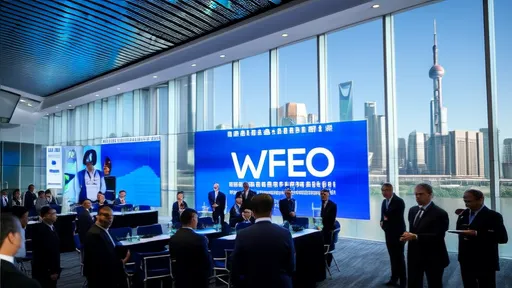
The grand assembly hall of the Shanghai International Convention Center witnessed a remarkable convergence of engineering brilliance as the World Federation of Engineering Organizations (WFEO) convened its General Assembly this week. Against the backdrop of Shanghai's glittering skyline, over eight hundred delegates from more than one hundred countries gathered for what many are calling the most significant engineering summit of the decade. The atmosphere crackled with intellectual energy as engineers, policymakers, and industry leaders exchanged ideas that would shape the future of global infrastructure and technological development.
The opening ceremony featured addresses from prominent figures including Chinese Minister of Science and Technology Wang Zhigang and WFEO President Gong Ke, who emphasized the critical role of engineering in addressing global challenges. The theme "Engineering for Sustainable Development: The Power of Collaboration" resonated throughout the five-day event, setting the stage for intense discussions about how engineering solutions can drive progress toward the United Nations Sustainable Development Goals. Delegates noted the particular significance of holding this gathering in Shanghai, a city that has transformed itself through engineering marvels into a global hub of innovation and development.
Technical sessions covered an impressive range of topics, from renewable energy systems and smart city infrastructure to water resource management and disaster-resilient construction. What made this assembly particularly noteworthy was the interdisciplinary nature of the conversations. Civil engineers debated with software developers about integrating artificial intelligence into urban planning, while environmental engineers collaborated with data scientists on climate modeling techniques. This cross-pollination of ideas across traditional engineering boundaries generated innovative approaches that many attendees believe will define the next generation of engineering practice.
One of the most anticipated events was the special session on climate change mitigation, where engineers from vulnerable nations shared sobering accounts of adapting infrastructure to increasingly extreme weather patterns. A delegation from the Pacific Islands presented compelling data on rising sea levels and their devastating impact on coastal communities, while engineers from drought-stricken regions in Africa demonstrated innovative water conservation systems. The session culminated in a unanimous resolution to establish an international engineering task force dedicated to climate adaptation strategies, with initial funding commitments exceeding twenty million dollars.
The exhibition hall buzzed with activity as universities, research institutions, and corporations showcased cutting-edge engineering innovations. Visitors marveled at scale models of China's recently completed Hong Kong-Zhuhai-Macao Bridge, detailed presentations on Japan's earthquake-resistant building technologies, and live demonstrations of Germany's latest renewable energy storage solutions. What distinguished this exhibition from previous years was the emphasis on scalable, affordable technologies suitable for implementation in developing economies. Several African delegates expressed particular interest in modular solar power systems and low-cost water purification units that could be deployed in remote villages.
Behind the main sessions, intense negotiations took place regarding international engineering standards and professional accreditation. Representatives from various national engineering bodies worked through numerous technical committees to harmonize safety protocols, ethical guidelines, and educational requirements. The most significant outcome was the Shanghai Accord on Engineering Education, which establishes mutual recognition frameworks that will enable greater mobility for engineering professionals across signatory countries. This agreement, years in the making, is expected to facilitate knowledge transfer and address engineering workforce shortages in critical regions.
The assembly also served as a platform for addressing the persistent gender gap in engineering. A well-attended Women in Engineering forum highlighted successful initiatives from several countries that have dramatically increased female participation in engineering programs. Data presented showed that nations with proactive policies supporting women in STEM fields have seen engineering workforce diversity improve by as much as forty percent over the past decade. The forum concluded with a commitment to establish an international mentorship program connecting established female engineers with students and early-career professionals from underrepresented regions.
Young engineers played a surprisingly prominent role throughout the proceedings. The WFEO Young Engineers competition attracted hundreds of entries from around the world, with the winning project being an affordable desalination system designed by a team from Malaysia. Beyond the competition, young professionals actively participated in technical sessions and networking events, bringing fresh perspectives to longstanding challenges. Many senior delegates remarked on the sophistication and global awareness demonstrated by these emerging engineering leaders, seeing in them the future of the profession.
The relationship between engineering and public policy received considerable attention during dedicated sessions. Engineers and government officials engaged in candid discussions about improving communication between technical experts and policymakers. Several presentations focused on case studies where effective collaboration had led to successful infrastructure projects, while others examined instances where communication breakdowns resulted in costly failures. The consensus emerged that engineers must become more engaged in the policy-making process, particularly as technological advancement accelerates and societies grapple with complex issues like automation, privacy, and sustainable development.
As the assembly entered its final day, working groups synthesized recommendations that will guide WFEO's activities for the coming two years. These include establishing new committees focused on emerging technologies like quantum computing and synthetic biology, creating an international database of engineering best practices, and launching initiatives to promote engineering as a career path in regions experiencing critical shortages. The closing ceremony featured the election of new WFEO officers and the announcement that the next General Assembly will be held in Berlin, continuing the tradition of rotating this important gathering among different continents.
The Shanghai assembly will be remembered not just for the technical knowledge exchanged but for the strengthened relationships among the global engineering community. As delegates departed for airports and train stations, conversations frequently turned to the collaborations and projects that would emerge from connections made during these five days. In an era of complex global challenges, from climate change to rapid urbanization, the value of this international engineering fellowship has never been more apparent. The work continues, but the Shanghai gathering has provided renewed momentum and direction for engineers committed to building a better world.

By /Oct 21, 2025

By /Oct 21, 2025

By /Oct 21, 2025

By /Oct 21, 2025
By /Oct 21, 2025

By /Oct 21, 2025

By /Oct 21, 2025

By William Miller/Oct 20, 2025

By /Oct 20, 2025

By /Oct 21, 2025

By /Oct 20, 2025
By /Oct 21, 2025

By /Oct 20, 2025

By /Oct 20, 2025

By /Oct 21, 2025

By Joshua Howard/Oct 20, 2025

By /Oct 20, 2025

By /Oct 20, 2025

By /Oct 20, 2025

By /Oct 21, 2025