In the perpetual twilight of the ocean's greatest abyss, a sphere of light pierced the darkness. Inside a titanium alloy cabin, built to withstand pressures beyond human comprehension, a team of explorers witnessed a world few have ever seen. The recent descent of a full-ocean-depth manned submersible to the Challenger Deep, the deepest point of the Mariana Trench, marks not merely another entry in the logbooks of oceanography, but a profound moment of human tenacity and technological triumph. This journey to the planet's final frontier is a testament to our enduring desire to push boundaries, to go where no one has gone before, and to understand the mysteries that lie in the crushing depths of our own world.
The Mariana Trench, a crescent-shaped scar in the western Pacific Ocean, has captivated scientists and adventurers for decades. The Challenger Deep, its deepest known point, is a place of almost mythical status. Reaching a depth of nearly 11,000 meters, it is a realm where the pressure is over a thousand times that at sea level, a force capable of imploding all but the most meticulously engineered vessels. For years, this domain belonged solely to unmanned probes and robotic landers, their cameras sending back grainy images of an alien landscape. The human presence was limited, a ghost in the machine, observing from the safety of a ship miles above. The return of a manned vehicle to this extreme environment changes everything. It re-establishes the human eye as the most sensitive instrument of discovery and the human mind as the most agile computer for on-the-spot analysis and decision-making in an unpredictable environment.
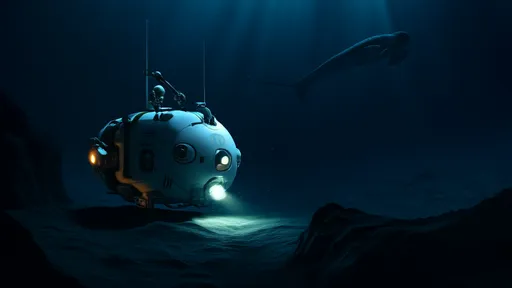
The submersible itself is a masterpiece of modern engineering, a product of years of dedicated research and development. Its central component is the personnel sphere, a meticulously crafted capsule designed to protect its human cargo from the immense hydrostatic pressure. Unlike the submarines that navigate the shallower seas, this vessel cannot have large viewports or flimsy hulls. Its sphere is made of a special titanium alloy, forged and machined to near perfection, with acrylic viewports that are thick enough to withstand the equivalent of placing the Eiffel Tower on a single square inch. Every seal, every electrical penetration, every bolt is a potential single point of failure, and thus, each one represents a monumental engineering challenge that was met and overcome. The vehicle is equipped with powerful LED lights to illuminate the perpetual darkness, sophisticated manipulator arms for collecting samples, and an array of high-definition cameras and sensors, turning the submersible into a mobile laboratory and film studio at the bottom of the world.
The descent is a slow, deliberate ballet into darkness. As the submersible leaves the support ship at the surface, it enters a world of fading light. The blue of the sunlit zone gives way to the twilight of the mesopelagic, and then to the absolute black of the bathypelagic zone and beyond. For hours, the only view from the viewport is the occasional "marine snow"—a continuous shower of organic detritus falling from the upper layers. The temperature drops, and the silence outside is absolute, broken only by the hum of the vessel's own systems. The pilots and scientists inside monitor their instruments closely, watching the depth gauge tick steadily upward—or rather, downward—into the abyss. The pressure outside climbs relentlessly, a constant, invisible threat that the sphere is designed to ignore, creating a fragile bubble of habitability in an utterly hostile environment.
Upon reaching the seafloor, a landscape both desolate and fascinating unfolds. The bottom of the Challenger Deep is not a barren, flat plain as once imagined. It features rolling hills, sediment-covered plains, and even hydrothermal vent systems in some sections of the trench. The powerful lights reveal the pale, ghostly colors of the seabed. The most startling discovery of such dives is always the presence of life. In this environment, where no sunlight penetrates and the pressure is crushing, life not only exists but has found a way to thrive. Strange, translucent sea cucumbers, resilient amphipods scuttling across the sediment, and even unique species of snailfish have been observed. These organisms are extremophiles, perfectly adapted to a world of cold, darkness, and immense pressure, their very biochemistry tuned to survive conditions that would be instantly lethal to almost any other life form on Earth. Collecting samples of these creatures and the surrounding water and sediment is a primary goal, offering priceless insights into the limits of biology.
The scientific implications of this manned mission are vast and multifaceted. By physically being on the seafloor, scientists can make real-time observations that are impossible for a remote-operated vehicle. They can react to unexpected discoveries, choose specific sampling sites with a geologist's eye, and gain a contextual understanding of the environment that is lost in the two-dimensional video feed from a robot. The samples brought back—water, rocks, sediments, and biological specimens—are pristine time capsules. They hold secrets about the geology of the Earth's crust, the chemistry of the deep ocean, and the evolutionary pathways that have led to such bizarre and specialized life. Furthermore, studying how these organisms withstand such extreme pressure can have applications in biotechnology and medicine, from the development of new enzymes to insights into human diseases related to pressure effects on cells.
Beyond pure science, this achievement carries significant symbolic weight. In an age where many believe the great age of exploration is over, the successful manned dive to the Challenger Deep serves as a powerful reminder that our own planet still holds vast, unexplored territories. It echoes the spirit of the Apollo missions to the moon, demonstrating that with vision, collaboration, and technological innovation, humanity can still achieve the seemingly impossible. It inspires a new generation of engineers, scientists, and explorers to look downward into the oceans with the same wonder and ambition that we once looked upward at the stars. The deep ocean is our inner space, and its exploration is just as critical to our future as the exploration of outer space, offering potential resources, a better understanding of climate change, and answers to fundamental questions about the origin and resilience of life.
The journey back to the surface is a slow decompression, not of the vessel, but of the human spirit. The crew ascends from a world of absolute silence and darkness, carrying with them the memory of an alien landscape and the data that will keep terrestrial scientists busy for years. As the submersible breaks the surface and is hoisted back onto the support ship, the mission is complete, but the work is just beginning. The successful descent to the Challenger Deep is more than a record-breaking stunt; it is a bold reaffirmation of human curiosity. It proves that the deepest, darkest, and most pressurized place on Earth is no longer beyond our reach. We have gone, we have seen, and we have returned, not as conquerors, but as humble students of a world that, despite our advances, still has much to teach us.

By /Oct 21, 2025

By /Oct 21, 2025

By /Oct 21, 2025

By /Oct 21, 2025

By /Oct 21, 2025

By /Oct 21, 2025

By /Oct 21, 2025

By William Miller/Oct 20, 2025

By /Oct 20, 2025

By /Oct 21, 2025

By /Oct 20, 2025

By /Oct 21, 2025

By /Oct 20, 2025

By /Oct 20, 2025

By /Oct 21, 2025
By Joshua Howard/Oct 20, 2025

By /Oct 20, 2025

By /Oct 20, 2025

By /Oct 20, 2025

By /Oct 21, 2025